


le 10 novembre 2026
Séminaire: 15h15
Frequency Comb as a Probe of Fluctuation Mechanisms in Nanomechanical System
Abstract:
Doubly-clamped nanostring resonators excel as high Q nanomechanical systems enabling room temperature quality factors of several 100,000 in the 10 MHz eigenfrequency range. Dielectric transduction via electrically induced gradient fields provides an integrated control scheme while retaining the large mechanical quality factor [1]. Dielectrically controlled nanostrings are an ideal testbed to explore a variety of dynamical phenomena ranging from multimode coupling to coherent control [2]. Here we will focus on the nonlinear dynamics of a single, resonantly driven mode [3].
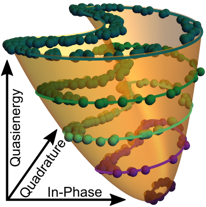
Under strong driving conditions, we observe an onset of self-sustained oscillation in the rotating frame. This phenomenon can be attributed to a resonantly induced negative effective friction force (RIFF) induced by the drive [4]. The high anharmonicity of the limit cycles manifests in the generation of a nanomechanical frequency comb in the power spectrum [5]. The frequency comb is centered around the forced vibrations initiated at the drive frequency, while the number and spacing of comb lines can be controlled by the drive detuning and power. To account for a non-zero linewidth of the comb lines, we extended the theoretical model to include phase diffusion. To experimentally access the shape of the comb lines, we have improved our measurement scheme to capture the true form of the comb lines with mHz resolution. The comb lineshapes reveal exponentially correlated Ornstein–Uhlenbeck frequency noise. Its correlation time agrees with the independently measured relaxation time of the vibrations. The resulting anomalous phase diffusion, as the comb itself, are rooted in the strong nonlinearity of the self-sustained vibrations.
[1] Q. P. Unterreithmeier et al., Nature, 458, 7241 (2009).
[2] T. Faust et al., Nat. Phys. 9, 485–488, (2013).
[3] M. Kallergi et al., arXiv:2608.02008.
[4] M. I. Dykman et al., Phys. Rev. Lett. 122, 254301 (2019).
[5] J. S. Ochs et al., Phys. Rev. X 12, 041019 (2022).